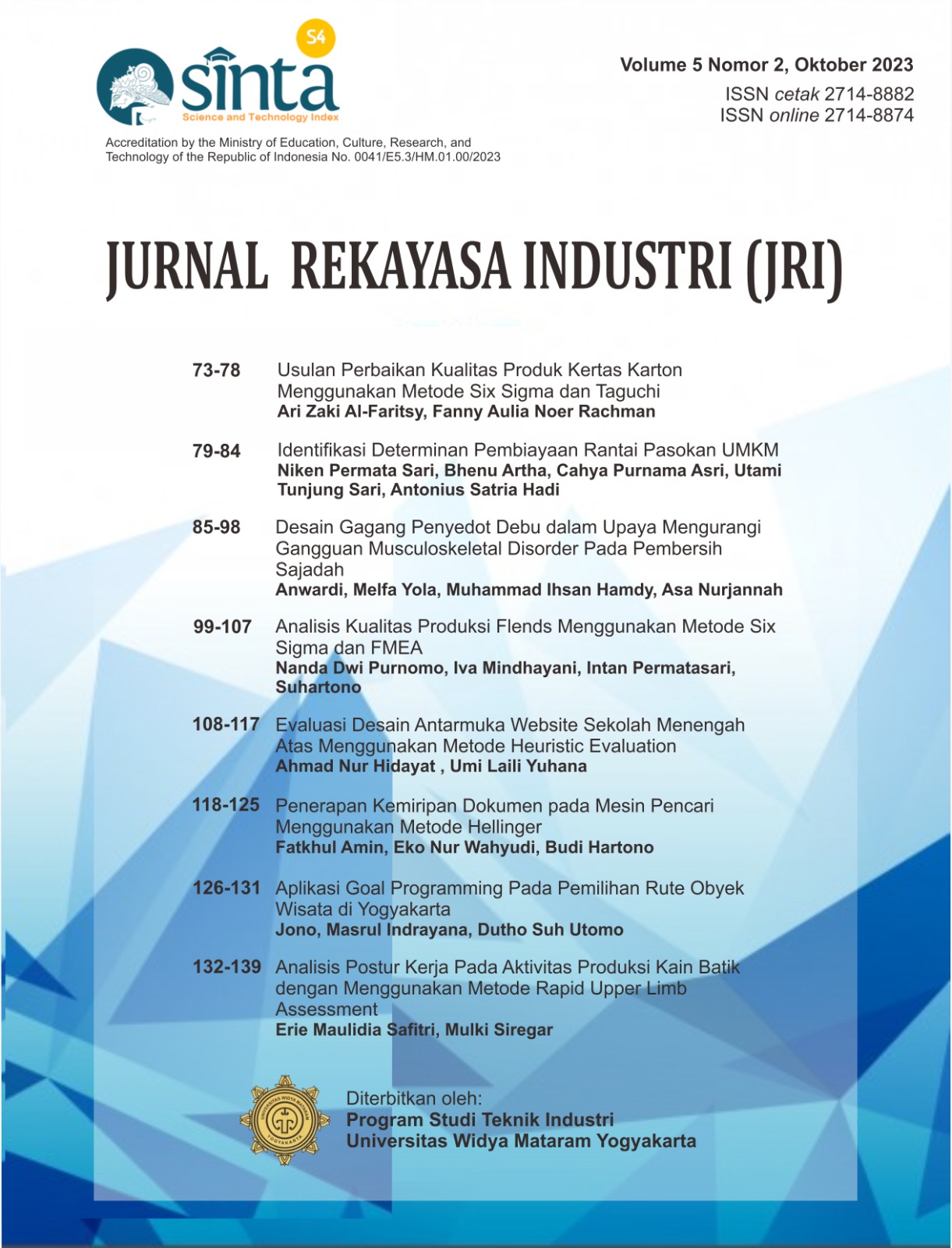
Identifikasi Determinan Pembiayaan Rantai Pasokan UMKM
DOI:
https://doi.org/10.37631/jri.v5i2.888Keywords:
teknologi digital; kolaborasi; institusi keuangan; pembiayaan rantai pasokan; UMKM.Abstract
Pembiayaan rantai pasokan merupakan hal yang penting bagi UMKM. Alternatif pembiayaan jangka pendek yang dapat memberikan bantuan untuk memperbaiki masalah kredit dan meningkatkan kinerja keuangan juga diperlukan UMKM. Tujuan penelitian ini adalah mengetahui pengaruh teknologi digital, kolaborasi, dan institusi keuangan terhadap pembiayaan rantai pasokan UMKM. Penelitian ini termasuk kuantitatif, yang menggunakan kuesioner sebagai instrumen pengumpulan data. Sampel ditetapkan dengan metode purposive sampling, dan dalam penelitian ini diperoleh 95 responden. Hasil penelitian menunjukkan bahwa teknologi digital, kolaborasi, dan institusi keuangan berpengaruh positif signifikan terhadap pembiayaan rantai pasokan UMKM.
References
Altay, N., Gunasekaran, A., Dubey, R., & Childe, S. J. (2018). Agility and resilience as antecedents of supply chain performance under moderating effects of organizational culture within the humanitarian setting: A dynamic capability view. Production Planning & Control, 29(14), 1158-1174.
Bajpai, N. (2017). Business Research Method. Second Edition. Pearson.
Basu, P., & Nair, S. K. (2012). Supply chain finance enabled early pay: Unlocking trapped value in B2B logistics. International Journal of Logistics Systems and Management, 12(3), 334-353.
Bhatnagar, R., & Teo, C. C. (2009). Role of logistics in enhancing competitive advantage. International Journal of Physical Distribution & Logistics Management.
Caniato, F., Gelsomino, L. M., Perego, A., & Ronchi, S. (2016). Does finance solve the supply chain financing problem? Supply Chain Management: International Journal, 21(5), 534-549.
Capaldo, A., & Giannoccaro, I. (2015). Interdependence and network-level trust in supply chain networks: A computational study. Industrial Marketing Management, 44, 180-195.
Chen, X., & Hu, C. (2011). The value of supply chain finance. Supply Chain Management-Applications and Simulations, 111-132.
Coulibaly, B., Sapriza, H., & Zlate, A. (2013). Financial frictions, trade credit, and the 2008-09 global financial crisis. International Review of Economics & Finance, 26, 25-38.
Craighead, C.W., Blackhurst, J., Rungtusanatham, M. J., & Handfield, R. B. (2007). The severity of supply chain disruptions: Design characteristics and mitigation capabilities. Decision Sciences, 38(1), 131-156.
Creazza, A., Dallari, F., & Melacini, M. (2010). Evaluating logistics network configurations for a global supply chain. Supply Chain Management: International Journal, 15(2), 154-164.
Fairchild, A. 2005. Intelligent matching: Integrating efficiencies in the financial supply chain. Supply Chain Management: International Journal, 10(4), 244-248.
Fawcett, S. E., Fawcett, A. M., Watson, B. J., & Magnan, G. M. (2012). Peeking inside the black box: Toward an understanding of supply chain collaboration dynamics. Journal of Supply Chain Management, 48(1), 44-72.
Fei, Y., & Yi-na, L. (2006). Research on relationship of supply chain partnership, information sharing, and operation performance. Industrial Engineering & Management, 6(1), 89-95.
Gunasekaran, A., Lai, K. H., & Cheng, T. E. (2008). Responsive supply chain: A competitive strategy in a networked economy. Omega, 36(4), 549-564.
Hofmann, E. (2005). Supply chain finance: Some conceptual insights. Beitrage Zu Beschaffung Und Logistik, 16, 203-214.
Jogja Dataku. Aplikasi Dataku Daerah Istimewa Yogyakarta. Tersedia pada: http://bappeda.jogjaprov.go.id/dataku/data_dasar/cetak/107-umkm. Diakses 30 Maret 2023
Jüttner, U., & Maklan, S. (2011). Supply chain resilience in the global financial crisis: An empirical study. Supply Chain Management: International Journal, 16(4), 246-259.
Kamble, S. S., Gunasekaran, A., & Himanshu, A. (2018). Understanding the Blockchain technology adoption in supply chains-Indian context. International Journal of Production Research, 57(7), 2009-2033.
Kamble, S. S., & Gunasekaran, A. (2020). Big data-driven supply chain performance measurement system: A review and framework for implementation. International Journal of Production Research, 58(1), 65-86.
Kamble, S. S., Gunasekaran, A., Ghadge, A., & Raut, R. (2020b). A performance measurement system for industry 4.0 enabled smart manufacturing system in SMMEs-A review and empirical investigation. International Journal of Production Economics, 229, Article 107853.
Kanwal, A., & Rajput, A. (2016). A transaction cost framework in supply chain relationships: A social capital perspective. Journal of Relationship Marketing, 15(1-2), 92-107.
Lekkakos, S. D., & Serrano, A. (2016). Supply chain finance for small and medium sized enterprises: The case of reverse factoring. International Journal of Physical Distribution & Logistics Management, 46(4).
Medina, E., Caniato, F., & Moretto, A. (2023). Framing Sustainable Supply Chain Finance: how can supply chain sustainability practices and supply chain finance solutions be integrated? Journal of Purchasing and Supply Management, 29(3), 100837.
Mulchandani, Ka., Jasrotia, S. S., & Mulchandani, Ke. (2022). Determining supply chain effectiveness for Indian MSMEs: A structural equation modelling approach. Asia Pacific Management Review.
Perego, A., & Salgaro, A. (2010). Assessing the benefits of B2B trade cycle integration: A model in the home appliances industry. Benchmarking: An International Journal, 17(4), 616-631.
Pereira, J. V. (2009). The new supply chain's frontier: Information management. International Journal of Information Management, 29(5), 372-379.
Pfohl, H. C., & Gomm, M. (2009). Supply chain finance: Optimizing financial flows in supply chains. Logistics Research, 1(3-4), 149-161.
Randall, W. S., & Farris, M. T. (2009). Supply chain financing: Using cash-to-cash variables to strengthen the supply chain. International Journal of Physical Distribution & Logistics Management, 39(8), 669-689.
Singh, K. (2007). Quantitative Social Research Methods. India: Sage Publications India Pvt Ltd.
Song, H., & Wang, L. (2013). The impact of private and family firms' relational strength on financing performance in clusters. Asia Pacific Journal of Management, 30(3), 735-748.
Song, H., Yu, K., Ganguly, A., & Turson, R. (2016). Supply chain network, information sharing and SME credit quality. Industrial Management & Data Systems, 116(4), 740-758.
Stemmler, L., & Seuring, S. (2003). Finanzwirtschaftliche Elemente in der Lieferkettensteuerunge Erste Überlegungen zu einem Konzept des Supply Chain Finance. Logistik Management, 5(4), 27-37.
Tanrisever, F., Cetinay, H., Reindorp, M., & Fransoo, J. (2012). Value of reverse factoring in multistage supply chains. Eindhoven: Working paper, Department of Industrial Engineering and Innovation Sciences, Eindhoven University of Technology.
Vieira, J. G. V., Yoshizak, H. T. Y., & Ho, L. L. (2015). The effects of collaboration on logistical performance and transaction costs. International Journal of Business Science and Applied Management, 10(1), 1-14.
Zhang, Q., Vonderembse, M. A., & Lim, J. S. (2003). Manufacturing flexibility: Defining and analyzing relationships among competence, capability, and customer satisfaction. Journal of Operations Management, 21(2), 173-191.
Downloads
Published
Issue
Section
License
Copyright (c) 2023 Niken Permata Sari1, bhenu artha, Cahya Purnama Asri, Utami Tunjung Sari, Antonius Satria Hadi

This work is licensed under a Creative Commons Attribution-ShareAlike 4.0 International License.

This work is licensed under a Creative Commons Attribution-ShareAlike 4.0 International License